The History of Marketing: 1,000 Years in 10 Minutes


The History of Marketing: 1,000 Years in 10 Minutes
Marketing did not begin with the Industrial Revolution. It began with a rabbit.
Understanding the history of marketing leads to better decisions today. Not because the past repeats itself, but because its core principles have remained remarkably stable. This article compresses over 1,000 years of brand management into the insights that matter most for marketing professionals today.
The Ancient Roots: Branding Before Industrialization
The common narrative holds that branding is a product of industrialization. That is incorrect. As early as the Song Dynasty (960–1279 AD), Chinese merchants used engraved metal stamps to create consistent visual identities.
The most famous example: the sewing needles branded «White Rabbit.» The rabbit was no coincidence — it was deliberate symbolism. It referenced the myth of an empress who ascended to the moon with her rabbit. For a predominantly non-literate female audience,this was a masterpiece of identity-based branding. Emotional, instantly recognizable, entirely without text.

Imperial seals on regional products, meanwhile, established a form of institutional trust that today's ISO certifications or influencer campaigns can only approximate.
Branding is not an artificial construct of capitalism. It is a fundamental social tool, built on trust, recognition, and emotional resonance. These principles apply today just as they did 1,000 years ago.
The Birth of a Discipline (1900–1930)
Around 1900, the word «marketing» appeared in no dictionary. Ten years later, it was an established term. What had happened?
Economists recognized that classical price theory could not explain why people buy what they buy. Factors beyond price moved to the forefront: advertising, distribution networks, the psychology of the sales conversation.
The intellectual foundation was laid by Peter Drucker with three axioms that remain valid to this day:
- «The aim of marketing is to make selling unnecessary.» When a product is perfectly tailored to the customer, it sells itself.
- «Business has only two basic functions: marketing and innovation.» Everything else is cost.
- «The purpose of a company is to create a customer.» The factory is not the center — the customer is.
Marketing is not a support function. Together with innovation, it is one of the two core functions of any organization. Anyone who views marketing as a "cost center" has not read Drucker.
The P&G Moment: The Invention of the Brand Manager(1931)
The architecture of the modern marketing department originated from a three-page internal memo at Procter & Gamble. Neil McElroy, a 28-year-old junior manager, proposed the «Brand Man» model. The reason was simple: his soap Camay could not compete against P&G's own giant, Lifebuoy.
McElroy's solution: each brand gets its own dedicated manager who analyzes regional sales data and makes targeted adjustments to pricing, distribution, and retail presentation. Marketing evolved from a general departmental function into a specialized, data-driven role.
This model dominated the corporate world for 50 years. P&G became a leadership training ground, and the system was exported into the automotive and service industries.
The origin of brand management was not a theoretical construct but an operational response to a concrete competitive problem. Effective marketing structures arise from real challenges, not from organizational chart exercises.
The Intellectual Flowering (1950–1970): The 4 Ps, STP,and Consumer Psychology
After World War II, marketing experienced a renaissance. The discipline shed its purely economic framework and embraced psychology and sociology. The central question shifted from «How many are buying?» to «Why do they buy?»
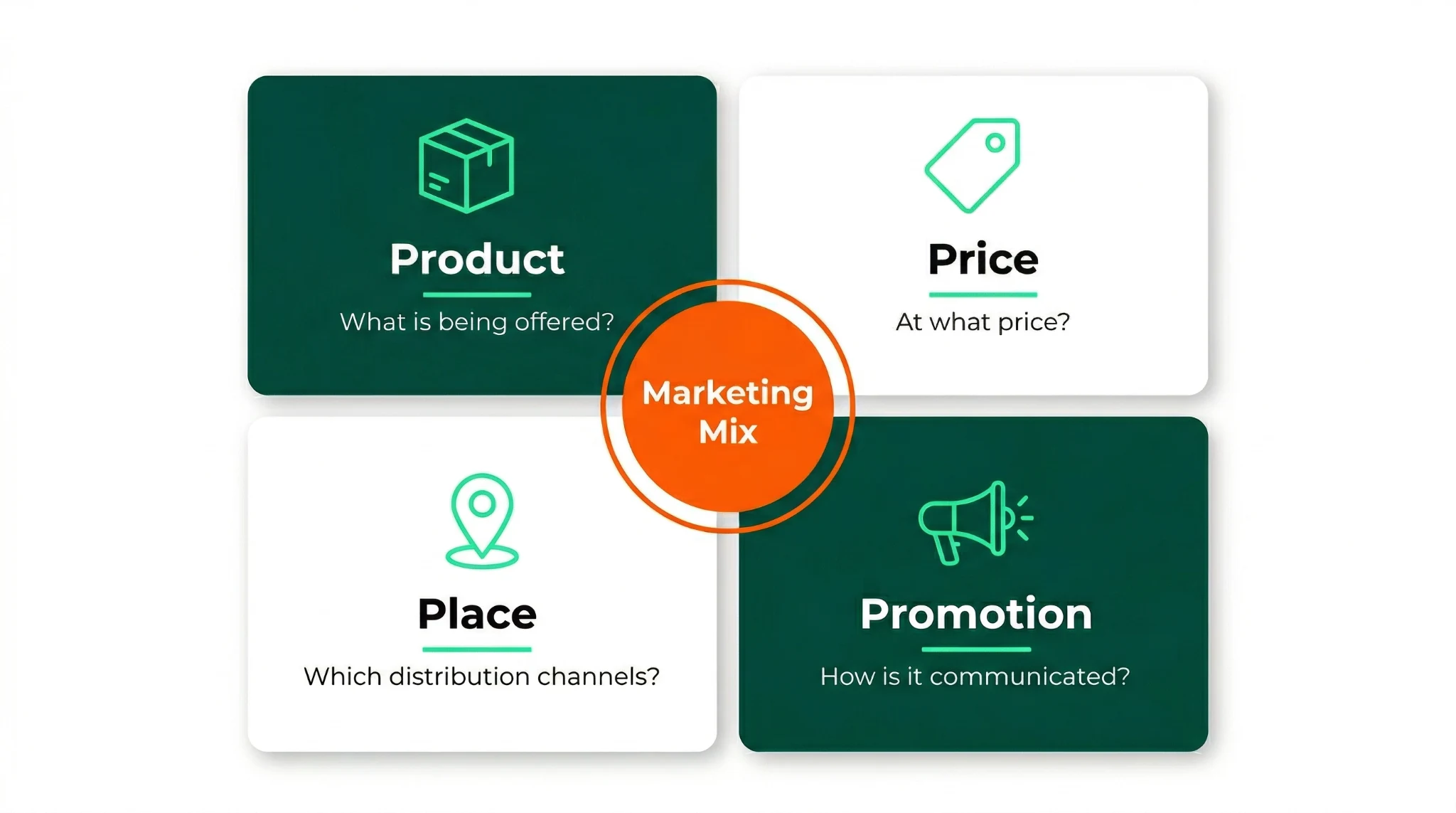
This era produced the frameworks that continue to shape our professional vocabulary today.
An often-overlooked thinker of this period was Wroe Alderson. He viewed marketing as an «organized behavioral system» and developed the theory of «double search»: buyers and sellers simultaneously seek each other out. Although his complex language caused simpler models to overtake him, his systems thinking still forms the foundation of strategic theory today.
The 4 Ps and STP are not outdated textbook concepts. They are the foundational language of strategic marketing work. Without mastering them, you are speaking marketing without grammar. At Flybridge, we regularly see in our strategy consulting how these fundamentals make the difference.
The Strategic Turn (1980–1999): Brand Equity and a Seat at the Leadership Table
In the late 1980s, a fundamental shift took place: brands were no longer viewed as tactical expenses but as long-term assets.
The turning point was marked by David Aaker's seminal work Managing Brand Equity (1991). Aaker defined the brand as an asset resting on three pillars:
- Relevance. Is the brand meaningful to the target audience?
- Image. What associations does it evoke?
- Loyalty. Do customers come back?
Aaker's decisive insight: awareness and image can be delegated to an agency. Loyalty cannot. It requires internal organizational change and the development of new offerings. This distinction gave CMOs a seat at the leadership table for the first time. They were no longer «the people who make ads» but guardians of the company's most valuable asset.
At the same time, this era brought a double-edged sword: scanner data. The unprecedented measurability at the point of sale tempted companies into short-term price promotions, destroying the very brand equity they were supposed to be building. A tactical trap that continues to occupy the industry to this day.
The tension between short-term measurability and long-term brand building is the central dilemma of modern brand management. Those who let themselves be driven solely by quarterly figures risk the substance of their brand. At Flybridge, we know this tension all too well from our work in brand positioning.
The Present (2000–Today): Data, Lifetime Value, and AI
In the 21st century, marketing has evolved into a data-driven discipline. The key metric is no longer market share but Customer Lifetime Value (CLV).
One example: Coca-Cola pursues a «life stage strategy». The company keeps consumers within its ecosystem for decades — from sugary soft drinks in their teenage years, to Smart Water, to tonic water later in life. It is not the individual purchase that counts, but the relationship across the entire lifespan.
At the same time, the communication model has fundamentally changed: from one-way broadcasting to two-way dialogue. The rise of «quiet luxury» illustrates this shift. Social status is no longer signaled through logos but through insider knowledge.
The four core objectives of modern marketing can be summarized as follows:
- Inform. Build awareness.
- Persuade. Create desire for the specific brand.
- Remind. Anchor the brand as a reference point.
- Engage. Build a reciprocal, value-based relationship.
And now the next wave is arriving: generative AI is changing not only how marketing is executed, but how consumers make decisions. LLM-based search systems like ChatGPT or Perplexity are fundamentally transforming the information process.
What Endures: Five Constants Across 1,000 Years
The history of marketing is not a linear progression. It is a cycle in which the same core principles reappear in new forms again and again. From the symbolic rabbit of the Song Dynasty to Coca-Cola's AI-generated advertising, the core task remains the same: shaping the interface between organization and human.
Frequently Asked Questions
When did marketing begin as a discipline?
Marketing as a distinct discipline emerged between 1900 and 1910, when economists began systematically examining factors beyond price: advertising, distribution, and psychology. The word «marketing» first appeared in dictionaries around 1910.
Who invented the 4 Ps of marketing?
The 4 Ps (Product, Price, Place, Promotion) were introduced by Jerome McCarthy in the 1960s. They distill the marketing mix into four controllable levers and remain among the most widely used frameworks in strategic marketing planning to this day.
What is brand equity and why does it matter?
Brand equity refers to the value of a brand as an intangible asset. David Aaker defined three pillars in 1991: relevance, image, and loyalty. Brand equity matters because it creates long-term corporate value that extends beyond short-term sales figures.
What can marketing professionals learn from thehistory of marketing?
The most important takeaway: the core principles — trust, symbolism, segmentation, customer centricity — have remained stable for over 1,000 years. What changes are the tools. Those who understand the principles can contextualize and strategically leverage any new tool.
Sources
- This article was inspired by the podcast «A History of Marketing» by Andrew Mitrak.
- Aaker, D. A. (1991). Managing Brand Equity. Free Press.
- Howard, J. A. & Sheth, J. N. (1969). The Theory of Buyer Behavior. Wiley.
- Drucker, P. F. (1954). The Practice of Management. Harper & Row.
- Kotler, P. & Keller, K. L. (2016). Marketing Management. Pearson.