Vibe Coding: When Natural Language Becomes a Programming Language

"English is becoming the most popular programming language." With this statement, Andrej Karpathy, co-founder of OpenAI and former AI director at Tesla, captured a fundamental shift in February 2025. What he meant: vibe coding. A new approach to software development where you describe your ideas in natural language and AI writes the code.
What Is Vibe Coding?
Vibe coding describes an approach where you no longer program line by line, but instead formulate your requirements in natural language. You tell the AI what you want, and it delivers working code.
The term was not chosen as Collins' Word of the Year 2025 by accident. Search queries surged by 6,700% in spring 2025. The difference from traditional programming? Instead of mastering syntax, you describe problems and solutions. Instead of writing, you communicate.
Warum ist das jetzt relevant?
One number stands out: 41% of code written worldwide is already AI-generated. Gartner predicts this share will rise to 60% by 2026. What was still an experiment two years ago is now mainstream: 92% of US developers use AI coding tools daily.
The productivity gains are measurable: 26% faster task completion on average, up to 81% for routine tasks. Interestingly, senior developers with over 10 years of experience benefit the most. They know what they want and can articulate it precisely.
Key Tools
Claude Code
Claude Code from Anthropic has established itself as the leading tool, both for professional developers and increasingly for technically minded business users. It works directly in the terminal or integrated into IDEs like VS Code. What makes it special: it understands entire codebases in seconds, navigates independently through project structures, and makes changes across multiple files.
In a widely noted experiment, Wharton professor Ethan Mollick let the system work autonomously for 74 minutes. The result: hundreds of code files for a functional startup, including payment processing. Claude Code achieves a score of 80.9% on the SWE benchmark, making it the world leader.
Lovable
Another exciting example is Lovable, a platform focused on rapid app development. You describe your idea in simple words, and the platform generates a production-ready application. From idea to working prototype in hours instead of months. The code belongs to you and can be exported.
For under $200 per month, you get what traditional development would cost tens of thousands. Ideal for MVPs, internal tools, or quick validation of business ideas.
Other relevant tools: GitHub Copilot (42% market share) and Cursor IDE (18%).
Not Just for the IT Department
A surprising statistic: 63% of all vibe coding users are not developers. It gets particularly interesting when you think beyond individual prompts: toward reusable automations.
A concrete example: Imagine every Monday morning a fully prepared weekly report lands in your inbox. Not created by an employee, but by a "skill": a predefined workflow that automatically aggregates data from your CRM, Google Analytics, and accounting, identifies trends, and formats everything in your corporate design.
This is not science fiction. Tools like Claude Code now offer so-called skills (reusable knowledge packages) and subagents (specialized AI assistants that work in parallel). One agent researches, another analyzes, a third writes. All at the same time.
What this means for different areas:
• Marketing: Campaign dashboards that update themselves. Reporting without an IT ticket.
• Operations: Process documentation that is automatically updated with every change.
• Sales: CRM analyses and lead scoring ready and waiting for you each morning.
• Research: Data analyses and visualizations on demand, without Python knowledge.
McKinsey reports that 62% of organizations are already experimenting with such autonomous workflows. The advantage: once set up, they are available to the entire team, including company-specific governance rules.
A Realistic Perspective
Despite all the enthusiasm: vibe coding is no silver bullet. 40% of junior developers admit to deploying AI-generated code they don't fully understand. 75% of R&D leaders express security concerns. For large projects with over 50,000 lines of code, teams report 41% more debugging time.
Quality varies: 75% of users experience inconsistent results. Vibe coding is a powerful tool, but it replaces neither expertise nor critical thinking. The best results are achieved by those who know what they want and can evaluate the output.
From Theory to Practice
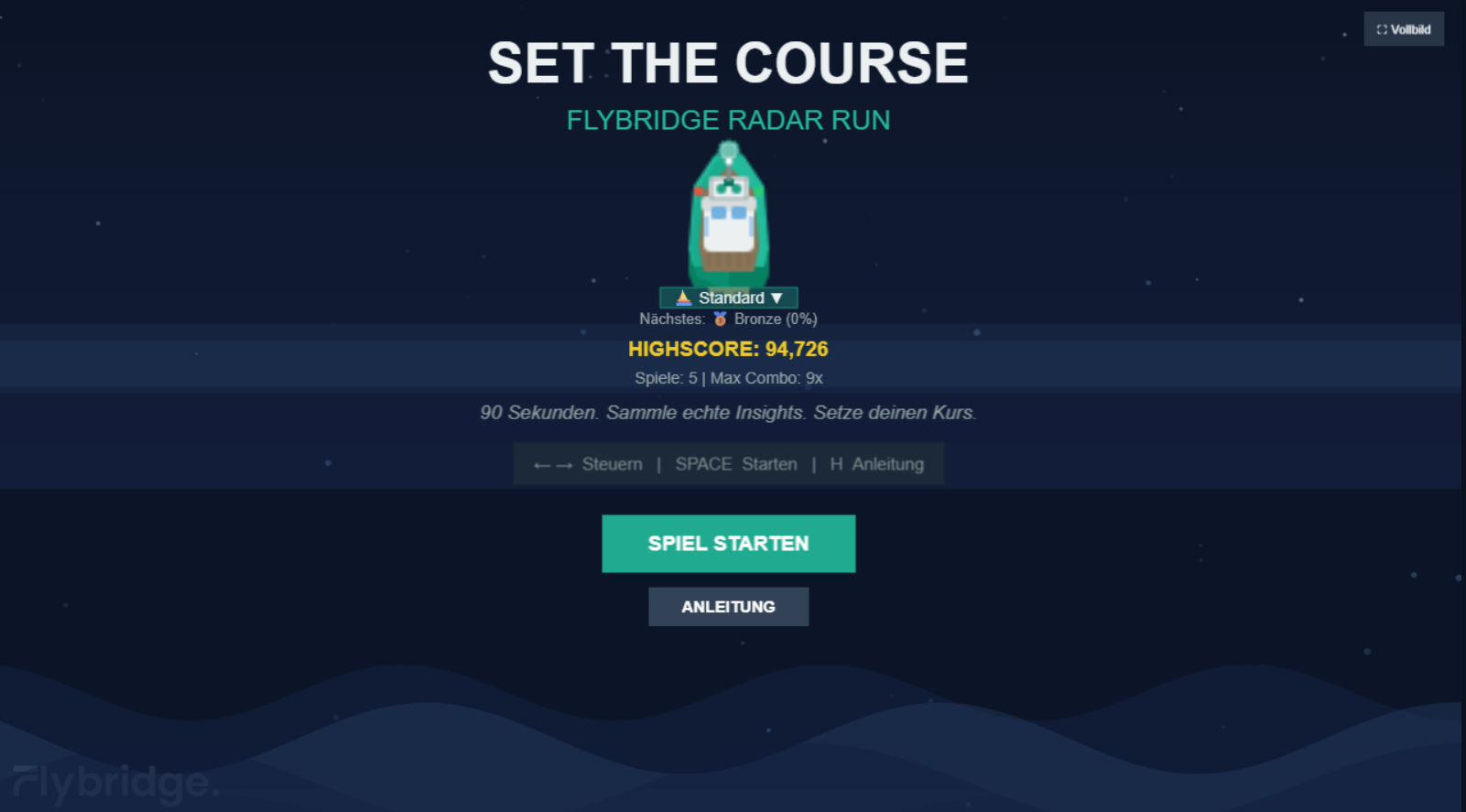
What does this actually feel like? To experience vibe coding firsthand, we ran a small experiment: an interactive browser game developed using exactly the methods described here. "Flybridge Radar Run" was created in a fraction of the time traditional development would have required: from game concept to programming to finished product.
In 90 seconds, you navigate through a data stream, collect insights, and make strategic decisions. No installation, directly in your browser.
Try it out: flybridge.ch/game
Vibe coding is changing how we develop software. And who can develop it. The question is no longer whether you can program. But whether you know what you want to build.
Sources
- Second Talent: Top Vibe Coding Statistics & Trends 2026
- Ethan Mollick: Claude Code and What Comes Next (One Useful Thing)
- MIT Technology Review: AI coding is now everywhere (Dezember 2025)
- IT Pro: AI could truly transform software development in 2026
- Anthropic: Claude Code – AI coding agent
- Lovable: AI App Builder