The genAI Pilot Era Is Over. The Integration Challenge Has Just Begun.


Imagine walking into an executive meeting and asking a seemingly simple question: How many generative AI use cases are currently running in this organisation? Someone mentions the official pilots. Another executive points to Copilot licences. A business-unit leader brings up a chatbot their team built. Marketing is experimenting with content generation. Finance has started automating analysis. Several employees are quietly using public genAI tools for tasks that were never formally approved.
Within minutes, the answer becomes clear: Nobody really knows. And that is not necessarily a failure of genAI adoption. It may actually be a sign that adoption has worked.
AI technologies have spread remarkably quickly through organisations. A recent European Central Bank (ECB) study of roughly 6,000 firms across 12 euro-area countries found that around 70% already use AI to some extent. Yet only 7% report investive use. Employees experiment, teams launch pilots, vendors add AI functionality to existing software and individual departments begin redesigning parts of their work.
The management challenge has therefore changed: The question shifts from “How do we get people to use genAI?” to “How do we build an organisation capable of continuously integrating genAI as the technology itself keeps changing?”
It requires organisations to decide which experiments should scale, where genAI should become part of core processes, how responsibilities between humans and machines should be designed, what governance is needed, how employees should be brought along and what genAI use communicates to customers and other stakeholders.
In other words, the genAI pilot era is ending. The integration challenge is beginning.
This is precisely the problem examined in our peer-reviewed publication, “Beyond Adoption: A Conceptual Framework for Integrating Generative AI in Organisations.” Based on in-depth interviews with managers and experts from 18 Swiss organisations across industries including finance, telecommunications, consulting, manufacturing, pharmaceuticals, tourism and transportation, the study investigates what happens after organisations have started using generative AI. Rather than asking why people adopt genAI, we asked what appears necessary to turn scattered experimentation into more stable, value-creating organisational integration.
Adoption is not integration
Traditional technology programmes tend to have a reassuring logic. Select a system. Implement it. Train employees. Drive adoption. Measure usage. Generative AI does not fit comfortably into that sequence. An employee can start using a new model before IT has evaluated it. A marketing team can redesign its content process without changing any formal system. A new model release can suddenly make a previously unattractive use case viable. An AI agent can move from helping an employee draft an answer to executing several steps of a workflow on their behalf.
At the same time, these decisions are increasingly visible outside the organisation. Customers may care whether customer support is human or artificial. Employees may interpret an “AI-first” strategy as a signal about future headcount. Business partners may impose their own requirements for data and genAI use. Regulators may constrain what can be automated. Generative AI is therefore not simply another software rollout.
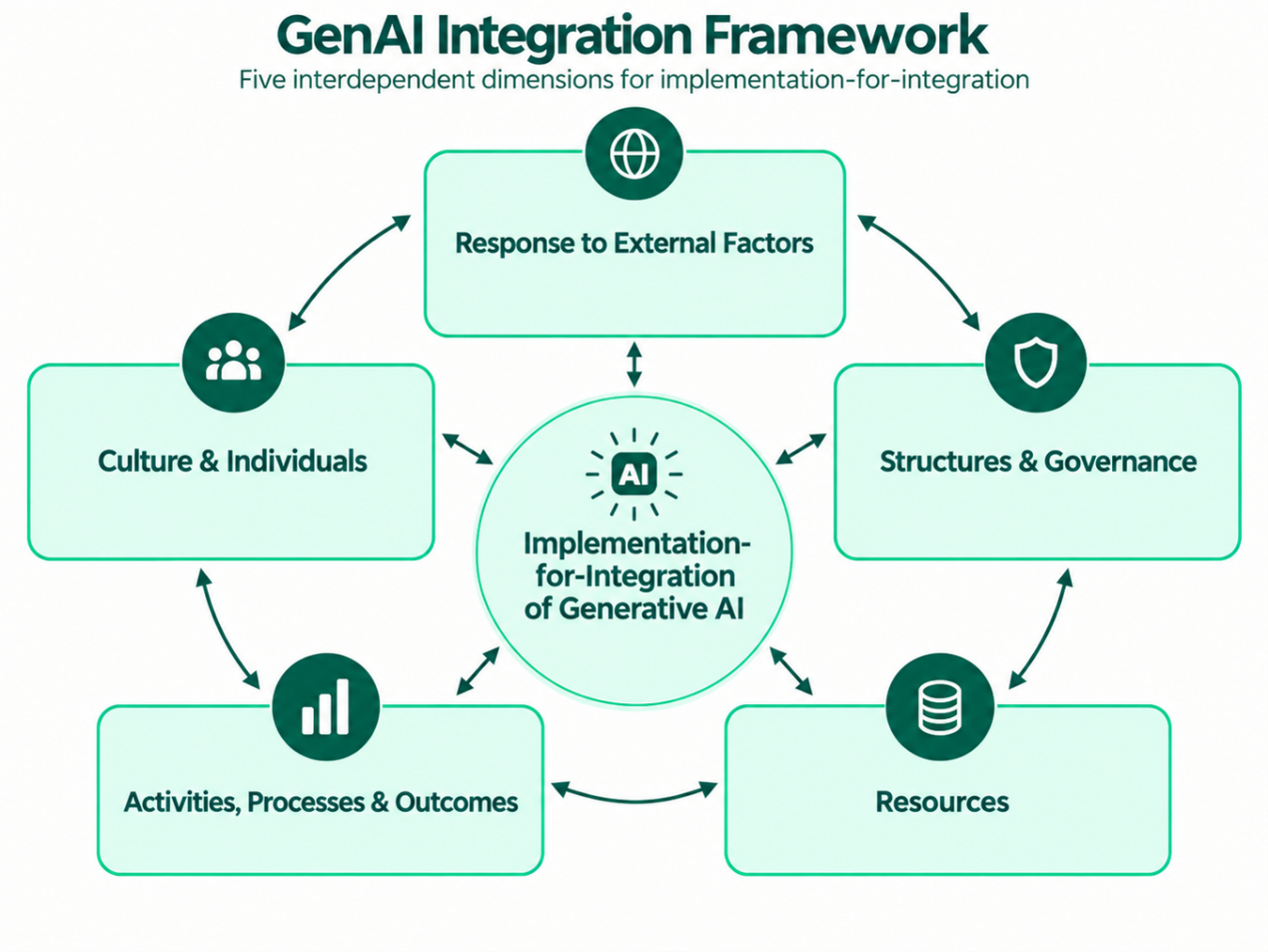
Our research suggests that organisations need to manage five interdependent dimensions simultaneously: external factors; culture and individuals; resources; activities, processes and outcomes; and structures and governance. There is no neat sequence from dimension one to dimension five. Progress in one area can expose weaknesses in another, which is why so many promising pilots struggle to achieve their transformative potential.
1. Look outside the organisation before scaling inside it
GenAI implementation does not stop at the organisational boundary. Regulation is the obvious consideration, particularly in industries such as banking, pharmaceuticals and other highly regulated environments. But our interviews revealed a broader challenge: Customers, suppliers, agencies, technology providers and other partners all influence what responsible genAI integration looks like. One particularly important question concerns transparency. Should customers be told that content was genAI-generated? Or that genAI played some role in the development of a product, or decisions? Does disclosure strengthen trust through transparency, or weaken perceived authenticity? Is genAI perfectly acceptable for one interaction but inappropriate for another?
There is no universal answer. A customer may happily interact with genAI to reschedule a delivery while strongly preferring human involvement in an emotionally sensitive complaint. GenAI-generated imagery might be perfectly consistent with one brand and deeply uncomfortable for another.
Before scaling a customer-facing application, ask yourself: What does this use of genAI signal about us? The answer can be as consequential as the productivity gain.
2. Stop treating genAI transformation as a training problem
When genAI adoption stalls, the standard response is often more training. Training matters. Our study found skill development as a major talking point across many of the organisations interviewed. But training alone is unlikely to create integration. Employees also need to understand why the organisation is using genAI, where it wants genAI to be used, where it does not, and what role humans are expected to retain. This is especially important because generative AI touches professional identity in ways that many previous technologies did not. For a designer, copywriter, consultant, software developer or analyst, genAI does not simply automate administration. It can perform activities that have traditionally signalled professional expertise.
Employees need room to experiment, but they also need psychological safety. Organisations need executive sponsorship, but purely top-down mandates risk creating compliance rather than curiosity. Bottom-up experimentation creates energy, but without coordination it can leave dozens of disconnected genAI islands across the business. The better model is simultaneous top-down direction and bottom-up exploration. That can mean internal genAI communities, documented experiments, or “AI champions” who connect central strategy with everyday work.
3. Fund genAI like a capability, not like a software licence
Buying licences is easy to budget. Building an organisational capability is harder.
Our interviews highlighted financial resources, time, dedicated responsibilities and skill development as important ingredients of integration. But the more interesting management question is how those resources are allocated. Not every possible use case deserves investment: as generative AI capabilities expand, organisations can quickly accumulate longlists of ideas. The temptation is to launch many pilots because experimentation is cheap.
The hidden cost appears later: fragmented tooling, unclear ownership and unused licenses. The organisations that progress beyond experimentation need to distinguish between what is technically possible and what is strategically worthwhile.
A useful investment conversation therefore starts with three questions:
- Where can genAI materially improve an activity?
- Does this investment free up other resources?
- And where could it change the economics of the business itself?
The third question is particularly easy to neglect. Most genAI programmes begin as efficiency programmes. But once genAI changes how something is produced, how quickly it can be delivered or how extensively it can be personalised, pricing, revenue models and value propositions may also need to change.
4. Redesign the workflow instead of sprinkling genAI on individual tasks
The natural first wave of generative AI use is task-based. Write this email. Summarise this document. Generate this image. Those applications create value, but they rarely transform the organisation. The bigger opportunity emerges when companies stop looking at individual tasks and start examining workflows.
Our research found organisations mapping existing processes, identifying high-potential activities and deliberately selecting the stage at which genAI should enter a workflow. Importantly, that does not always mean automating the entire process. Sometimes the highest-value design inserts genAI into one controlled step while retaining human judgement elsewhere.
Managers should therefore start asking: “What outcome is this process supposed to create, and how would we design the process today if genAI capabilities were available from the beginning?” However, without a measurement logic, this is where organisations risk building impressive demonstrations rather than valuable capabilities.
5. Build flexible governance
The instinctive response to genAI risk is often more control. That is understandable. Organisations need clear rules around sensitive data, approved tools, human oversight, accountability and compliance. Shadow AI and inadvertent data leak age are genuine concerns highlighted across the research.
But there is a catch. Governance built for today’s genAI capabilities can become obsolete remarkably quickly. The objective should therefore be to create a governance system capable of changing. Our study points towards a balance between centralisation and decentralisation. Central teams can establish common infrastructure, security requirements, principles and oversight. Business units closer to customers and processes need enough freedom to adapt implementation to their context.
And governance needs a recurring rhythm. A model that was approved yesterday may be replaced tomorrow. New legislation, stakeholder expectations or technical capabilities may alter what is acceptable. The organisations that integrate genAI successfully will therefore not be those that write the most comprehensive policy once. They will be those that get good at revisiting it.
The real capability is continuous reconfiguration
Sustainable genAI integration may depend lesson possessing a particular genAI asset and more on developing what strategy research calls dynamic capabilities: the organisational ability to recognise change, act on opportunities and repeatedly reconfigure resources, processes and structures as conditions evolve.
For generative AI, that idea becomes quite practical. It means regularly reconsidering which use cases matter. Updating governance as models evolve. Revisiting customer expectations. And occasionally questioning the business model itself. GenAI integration is thus an organisational capability. That is also why copying another company’s “AI-first” playbook is unlikely to be enough. The right configuration depends on industry, regulation, organisational complexity, culture, brand, customers and existing technology.
There may be no universal genAI transformation blueprint. But there is a much better set of questions to ask.
Five key takeaways for leaders
- Adoption is only the beginning.
High employee usage and large numbers of pilots can coexist with very little organisational transformation. Shift the management conversation from access and adoption towards processes, value creation and integration. - Treat genAI as organisational change, not an IT rollout.
Technology, people, governance, external stakeholders and business models interact. Optimising one while ignoring the others creates bottlenecks somewhere else. - Move from use cases to workflows.
Individual productivity gains matter, but larger value pools emerge when organisations redesign end-to-end processes and deliberately decide where humans and genAI should each contribute. - Make governance adaptive.
Create clear boundaries for data, tools, accountability and human oversight, but build mechanisms to revisit them continuously. With generative AI, governance is a management process, not a finished document. - Build the capability to keep changing.
Today’s leading model, workflow or policy will not remain optimal. Sustainable advantage is therefore unlikely to come simply from having access to genAI. It comes from becoming better than competitors at repeatedly integrating what genAI makes possible.
The genAI pilot era has shown organisations what generative AI can do. The next competitive question is whether they can redesign themselves around what it makes possible.
Read full chapter here.