Brand Positioning: The Foundation of a Strong Brand


When people go to the supermarket to buy water, they usually spend only a few seconds in front of the refrigerated shelf before choosing a bottle. At first glance, all the bottles of water promise the same thing: to quench thirst. And yet,different images form in customers’ minds.
This is exactly where brand positioning comes in. It defines who the brand is relevant to, how it is perceived, and what sets it apart from other options. In other words, it answers the question of why customers choose this particular bottle of water.
Where brand positioning takes shape
To build a strong brand position, it helps to consider three factors: target audience relevance, credibility and differentiation.
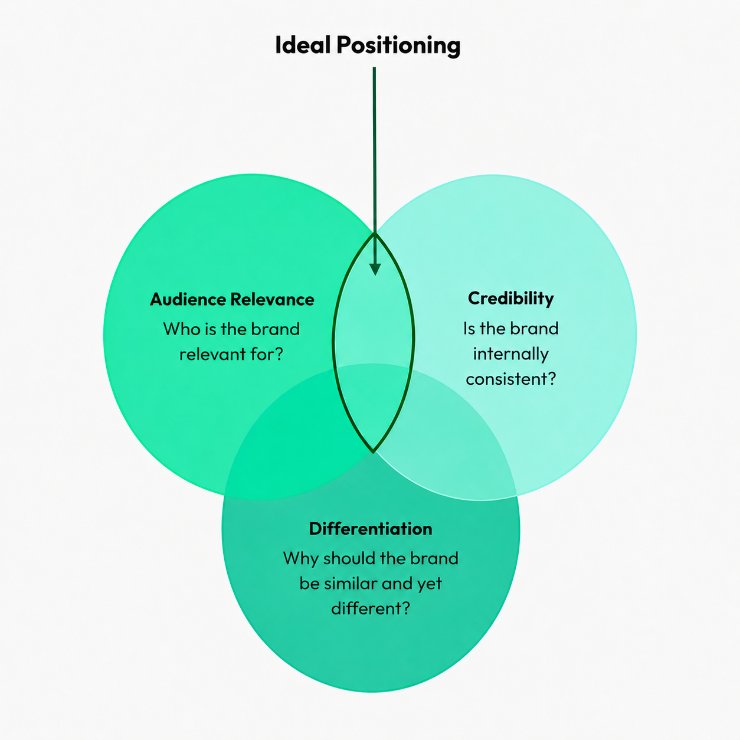
While each factor is important on its own, none of them alone constitutes a complete positioning. It is only at the intersection that a clear space emerges that is relevant to the target audience and that the brand can credibly occupy, setting it apart from the competition.
Target audience: Who is the brand relevant for?
The first step is to define your target audience. This involves determining who your potential buyers are and what their needs are. Understanding your target audience also means knowing their demographic, socioeconomic and psychographic characteristics.
You can learn more about identifying your target audience here.
Credibility: Is the brand internally consistent?
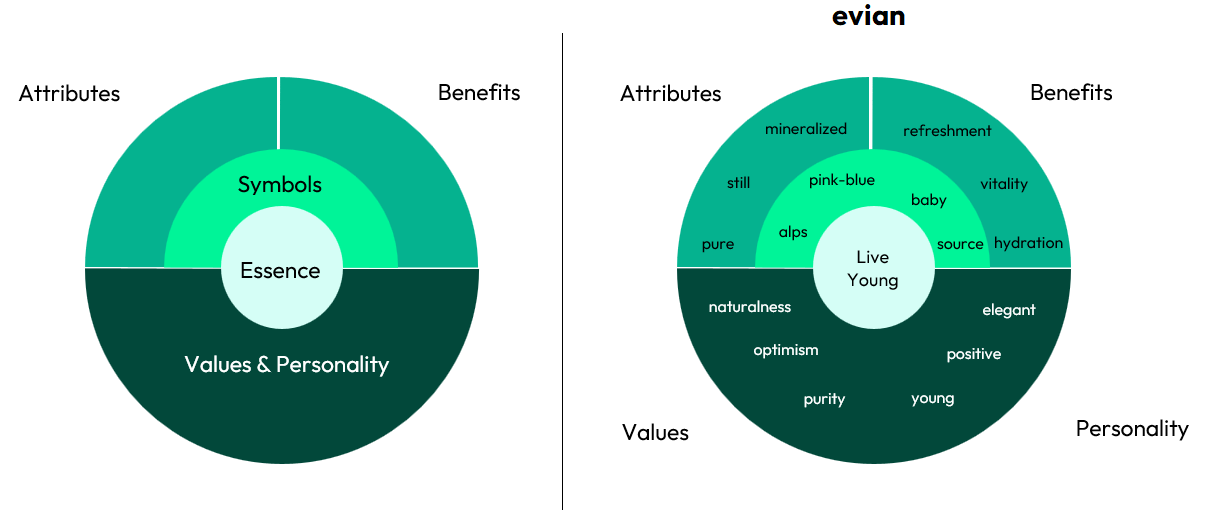
A credible brand positioning can be broken down into three key questions:
- Who am I? (essence and values)
The brand essence distils a brand’s identity down to its core. Brand values complement this by defining the fundamental beliefs and principles that the brand stands for. Together, they provide internal and external guidance.
- What do I offer? (attributes and benefits)
Brand attributes describe the qualities and characteristics of the offering, while brand benefits describe the promise that the brand makes to customers. We explore the roles that brands and products play for customers in our blog post on the JTBD framework.
- What am I like? (personality and symbols)
Brand personality describes the human traits associated with a brand, while symbols enhance its recognizability.
The Brand Essence Wheel is a useful tool for illustrating this. It helps present the key questions about the brand in a structured way. The following example shows what this might look like:
Differentiation: Why should the brand be similar and yet different?
Many companies associate differentiation with being different. But that’s only partly true.
A brand doesn’t have to be different in every aspect. Often, it’s important to deliberately appear similar in certain areas in order to be considered a viable option. For example, a bank must inspire trust, and a hospital must convey a sense of hygiene.
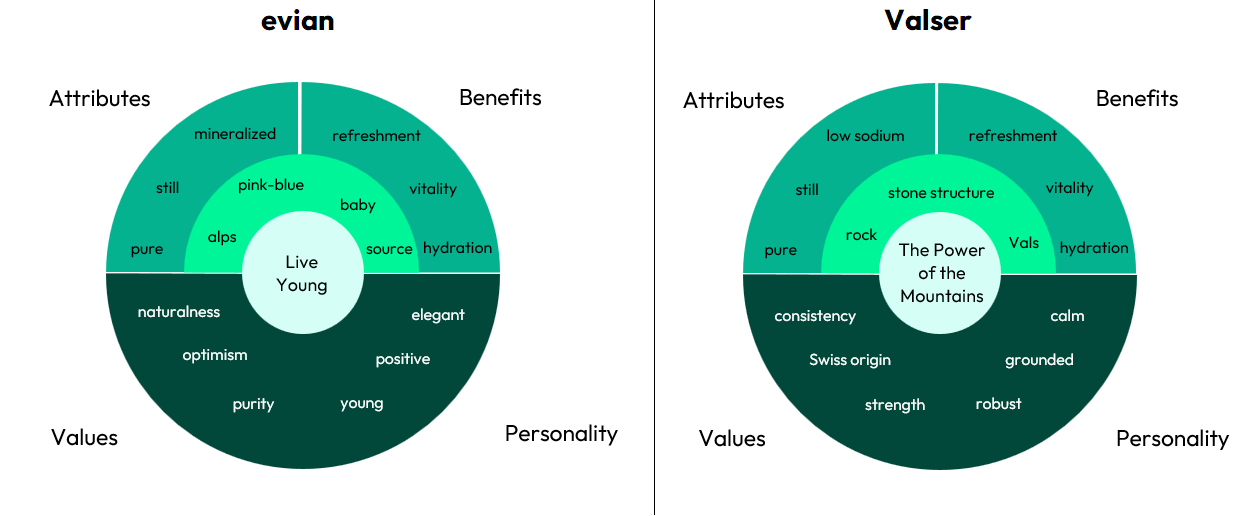
It is not enough for a company to analyze its own brand; it must also compare it with its key competitors. Only through comparison can it be determined which characteristics are expected in a category and where true differentiation can emerge. The crucial question, therefore, is: In which areas do we need to be similar enough to be accepted, and in which areas do we need to be different enough to be chosen?
This becomes clear when comparing evian and Valser, for example. Both brands offer still mineral water for on-the-go consumption and target customers at similar points of purchase. They are quickly selected at the supermarket and must be appealing at first glance. This makes them “similar enough” to be perceived as relevant options within the same purchasing context. However, they differentiate themselves through their brand image: evian stands for lightness, youthfulness and natural purity, while Valser stands for Swiss origin, minerality and the power of the mountains. Therefore, although both brands operate in the same market, they evoke different associations in customers' minds.
Checklist for a strong brand positioning
Once you have refined your positioning strategy, it is worth taking a closer look to see if it is having the desired effect. The following questions will help you evaluate the three factors:
- Is it clear who the brand is relevant to?
- Are the core needs of the target audience known?
- Is it clear what the brand fundamentally stands for?
- Do the brand’s attributes, benefits, symbols, values, and personality align?
- Are the similarities and differences compared to the competition clear?
- Can this positioning be sustained over the long term?
The last question is particularly important: a positioning statement does not gain strength by being constantly reformulated. It becomes strong when it remains consistently tangible over the long term, thereby creating clarity, trust, and brand recognition.
However, long-term consistency does not mean that positioning is a one-time task. Rather, it provides an ongoing framework for strategy, communication and brand presence. This is especially worth bearing in mind during times of change, such as during a rebranding. This refreshes the brand’s image and strengthens its clarity. After all, a strong brand isn’t the one that communicates the loudest, but the one that is understood the most clearly.
How clearly is your brand positioned? Using customer and employee surveys, as well as brand analyses, we can show you how your brand is currently perceived and where there is potential for improvement.
Source
Homburg, C.(2020). Marketing Management: Strategy, Tools, Implementation, Corporate Management (7th rev. and expanded ed.). Wiesbaden: Springer Gabler.